the two forgotten factors in every meeting room
Why acoustics and lighting weigh just as heavily as the equipment
The setup looks perfect on paper. A top-tier camera, good microphones, a screen that displays everything in razor-sharp detail. And yet the meeting feels off: voices sound hollow, faces look dim or too dark.
Often the problem isn't the equipment, but the room around it. Acoustics and light determine just as much about how a meeting feels as the hardware itself, yet they rarely appear on a quote. That's why at VCS we always look beyond the list of devices: at the walls, the ceiling, the windows, and how they interact with one another.
Even the best microphone can't fix poor acoustics
A microphone doesn't just pick up a voice. It also picks up everything that voice does after it leaves the speaker: bouncing off glass, reflecting off a hard floor, lingering against a bare ceiling. The longer sound keeps ringing, the harder the conversation becomes to follow for anyone listening remotely.
Two figures largely determine whether a room sounds good.
The first is RT60: the time (in seconds) it takes for sound to noticeably quiet down after it stops. The higher that number, the longer a word keeps “hanging” and blending into the next one - the more the room echoes. For a meeting room, aim for an RT60 between 0.4 and 0.6 seconds, the rule of thumb from AVIXA and audio manufacturer Biamp.
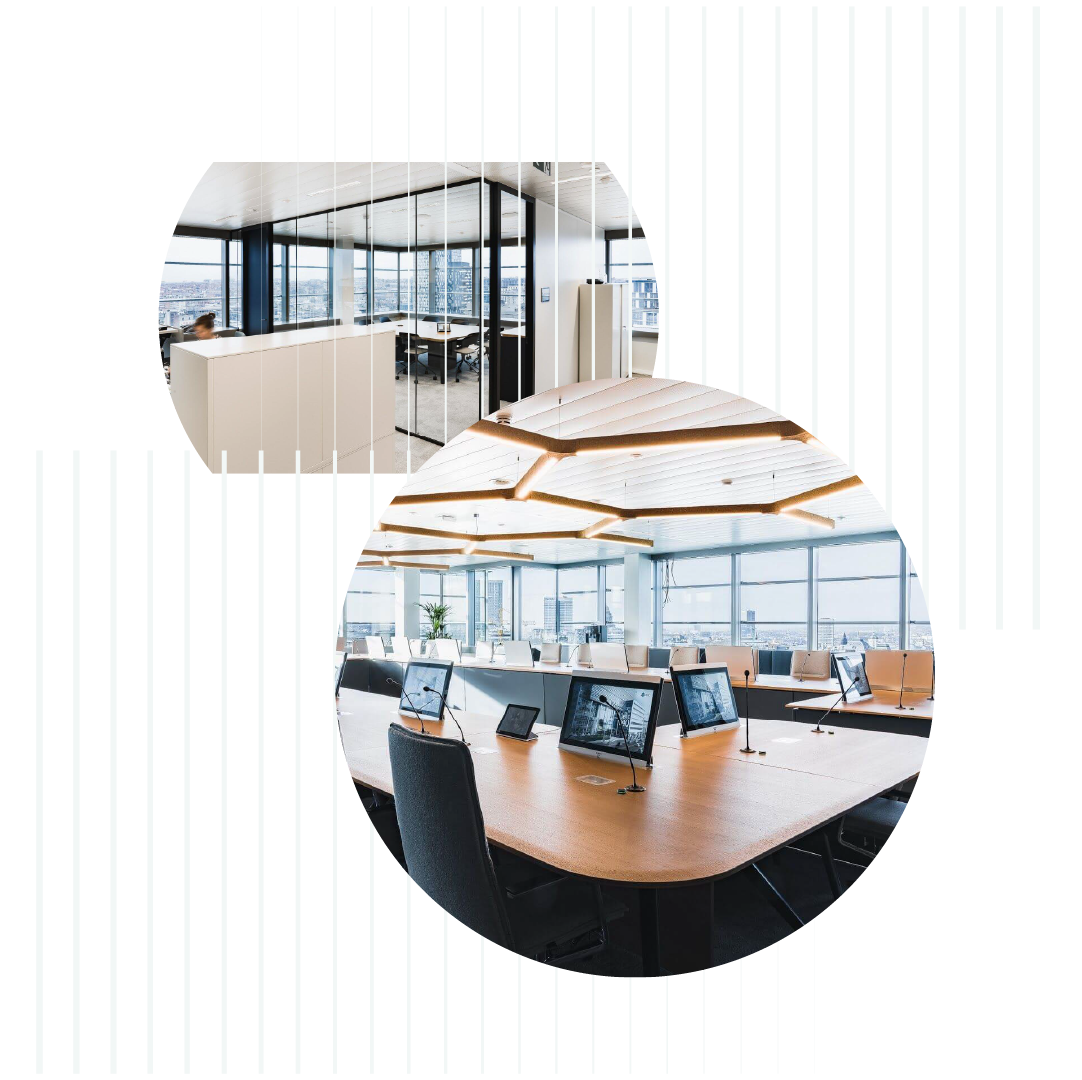
Interestingly, the most popular office trend of recent years - glass meeting boxes - often sits well above that: lots of glass and few soft surfaces let sound linger too long.
The second is the NC rating (Noise Criteria): how quiet the constant background noise is, such as humming ventilation or a droning air conditioner. The lower the number, the quieter the baseline, and the less a microphone has to “boost” to lift a voice above it. Aim for an NC value below 30.
Professionals call the spots where sound first bounces back “first reflection points” - often the tabletop or the window directly opposite the speaker. Softening those spots, with a rug, curtain, or acoustic panel, is often exactly what a good microphone needs to reach its full potential.
A simple test without any measuring equipment: clap loudly once in an empty room. If you hear a “ring” that lasts longer than half a second, the room is too reverberant, no matter how good the microphone is. A professional measurement goes further: reverberation time is mapped per frequency, so the solution can be precisely tailored to that specific room.
Even the best camera can't fix the wrong light
The same applies to image. A camera can only show what the light in the room gives it. Put someone with their back to a window, and the camera compensates by darkening the rest of the image - the face becomes a silhouette. That's called backlighting, and it's one of the most common - and easiest to avoid - mistakes in meeting rooms.
Two things largely determine whether a face looks bright or dull on camera: the amount of light and its colour temperature.
Aim for around 300 to 500 lux at face height. Lux is the unit for light intensity: how much light actually falls on a surface. Also aim for a colour temperature between 3500 and 4000 kelvin, neutral white, for a natural skin tone on camera.
That's why, during an assessment, we take into account exactly where a face will be positioned, and how daylight shifts throughout the day. A room that's perfectly lit in the morning can face a harsh, low sun by the afternoon - anticipating that, for example with lighting controls or adjustable sun shading, makes the difference between a room that “happens” to look good and one that does so structurally.
Why this rarely appears on a quote
Anyone who only sells hardware quotes a camera, a microphone, and a screen - measurable products with a price tag. Acoustics and light aren't products you tick off a list, but properties of the room itself, which means they need to be looked at before installation, not only once users start complaining afterward.
A thorough assessment goes further than a surface-level glance: reverberation and light incidence are mapped out alongside materials, windows, and ceiling height. That combination of expertise and attention to detail is what sets a tailor-made solution apart from a standard package. The result: a room that genuinely feels right from the very first meeting.
What you can do about it
A few interventions that often solve a lot already:
- Acoustic panels or curtains, against glass walls, to break up reflection.
- Soft materials, such as carpet or acoustic ceiling tiles, to shorten reverberation time.
- Consistent lighting in a single colour temperature throughout the room.
- No backlighting: never place cameras directly facing a window without light from the front.
None of these interventions require a whole new installation - just a look at the room, not only at the equipment list.
Let us be your guide
Not sure whether your meeting rooms are ready, acoustically and in terms of lighting, for hybrid meetings? Book an appointment with us - we're happy to look together at what each room needs.
Discover the future of meeting solutions at vcsolutions.be.
E-mail: vcs@vcsolutions.eu Phone: +32 (0) 16 38 36 70