Does the Other Side of the Line Still Hear Your Meeting Room?
A question every IT manager eventually gets on their desk
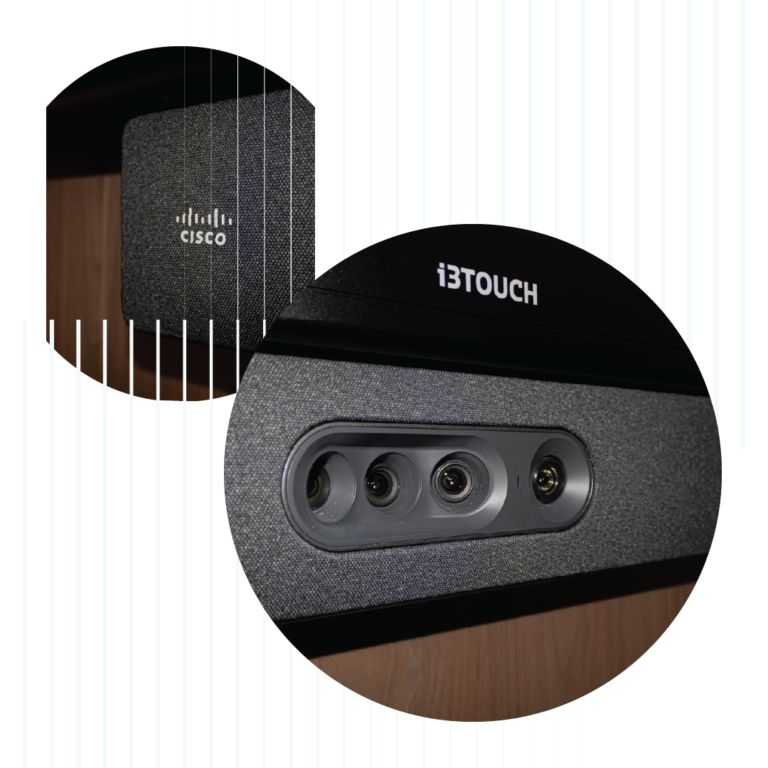
Video bars have shown up everywhere by now: in every huddle room, in most small meeting rooms, and usually for good reason.
A single device that combines camera, microphone and speaker, quick to deploy and without complicated cabling. For most of your rooms, that’s exactly what’s needed. But not for all of them and that’s usually something you discover once the complaints start coming in.
Not because the technology is bad, but because every device is built for a certain scale.
Where a video bar simply does its job
In a huddle room or small meeting room, there’s nothing wrong with a video bar. It’s actually the right choice.
Camera, microphone and speaker in a single unit: fewer components that need to work together, less chance of something breaking, and a lower price tag. For a team of four to eight people around a table, everyone hears and sees each other perfectly.
Where it breaks down: it's simply physics
The issue isn’t that the technology is poor — it’s that every device has a range. A microphone picks up a voice clearly up to a certain distance, and beyond that it gets quieter and fuzzier. Sit just outside that range, and you sound like you’re talking through a cardboard tube.
That matters more than you’d think. People tolerate a slightly less sharp image just fine, but the moment they can’t understand someone anymore, they mentally check out within minutes.
The same thing happens with the camera: a video bar films a fixed, limited angle. If your team sits close together, no problem. But once the table gets longer or people spread out across the room, someone always ends up just outside the frame.
A rule of thumb, not an exact line
There’s no magic number where a room becomes “too big” – but there is a logic that shows up everywhere: choose a device whose range is slightly larger than your room, not exactly equal to it. For a four-metre room, pick a device that reaches a little further. From around four and a half to five metres, industry professionals recommend a model with multiple speakers, supplemented with separate microphones.
AVIXA, the international professional association for AV experts, draws the same line: for medium-sized rooms they recommend separate components – a camera that can track movement, ceiling microphones, wall-mounted speakers – while a genuinely large room deserves a fully custom-built system.
What you need beyond that point
Past that point, a single device no longer replaces the full installation. Instead, you build a tailored AV solution:
- Ceiling microphones, distributed across the room, so every seat at the table is picked up equally well.
- Multiple cameras that detect who’s speaking, so no one falls outside the frame, wherever they’re sitting.
- A separate audio processor (DSP), which brings all the microphones together into one clear, consistent sound – no echo, no peaks.
Nothing excessive.
Just the same question – does everyone hear and see each other clearly – answered on a larger scale.
Let us be your guide
Wondering whether your meeting rooms still fall within a video bar’s range? Get in touch – we’re happy to think it through with you, room by room.
Discover the future of meeting solutions at vcsolutions.be.
E-mail: vcs@vcsolutions.eu Phone: +32 (0) 16 38 36 70